For years, healthcare cybersecurity conversations focused on prevention.
Prevent ransomware.
Prevent phishing.
Prevent unauthorized access.
Prevent breaches.
Those goals still matter.
But healthcare leaders are increasingly facing a harder reality: no organization can prevent every cyber incident, outage, vendor failure, or technology disruption.
Threats evolve. Cloud environments change. Vendors add dependencies. Staff use more applications. Medical devices connect to networks. Phone systems, EHR platforms, billing workflows, and patient communications all rely on technology working when it is needed most.
That is why the conversation is shifting.
The question is no longer only, “How do we stop every attack?”
The better question is, “How do we keep serving patients when something goes wrong?”
That question sits at the center of healthcare cyber resilience.
Healthcare cyber resilience is the ability to anticipate, withstand, recover from, and adapt to cyber disruptions while maintaining critical operations and supporting patient care.
It includes cybersecurity, but it goes further. It integrates access controls, endpoint and device management, monitoring, response, backup, recovery, communications continuity, vendor readiness, evidence, and leadership visibility into a single practical operating model.
For healthcare organizations, resilience is not simply an IT objective.
It is a patient care objective.
Executive Read: What Healthcare Cyber Resilience Means
- Healthcare cyber resilience is the ability to keep critical operations moving during and after cyber incidents, outages, vendor disruptions, or technology failures.
- Cybersecurity focuses on reducing the likelihood of an incident. Cyber resilience also focuses on reducing the impact of an incident.
- The HIPAA Security Rule requires safeguards to protect the confidentiality, integrity, and availability of electronic protected health information (ePHI). 1
- HHS risk analysis guidance emphasizes evaluating risks and vulnerabilities to ePHI as a first step in selecting reasonable and appropriate safeguards. 2
- The proposed HIPAA Security Rule updates signal stronger expectations around MFA, encryption, vulnerability management, recovery, business associate oversight, and documentation. 3
- Resilience should connect HIPAA readiness, ransomware readiness, downtime planning, EHR access, phones, networks, cloud systems, identity, monitoring, vendors, backups, and evidence.
- DataTel’s HIPAA Readiness Assessment helps healthcare organizations calculate downtime exposure, identify readiness gaps, and receive a prioritized 90-day roadmap.
Reviewed by:
DataTel Healthcare Cybersecurity Specialists
The Patient Care Test
A resilience strategy should begin with a simple test.
If a critical system became unavailable tomorrow, could your organization still serve patients safely and consistently?
That question changes the cybersecurity conversation.
It moves the focus from individual safeguards to real operational impact.
A firewall matters. So does MFA. So does endpoint protection. So does backup. But healthcare leaders also need to know what happens when phones fail, when the EHR is unavailable, when staff cannot reach cloud systems, when a vendor delays recovery, or when a ransomware event forces the organization into downtime procedures.
Cybersecurity becomes more practical when every decision is tied to care continuity.
Ask:
- Can clinicians access the information they need?
- Can patients reach the organization?
- Can staff communicate internally?
- Can scheduling, billing, referrals, prescriptions, and documentation continue?
- Can leadership see what is happening clearly enough to make decisions?
- Can vendors respond quickly when they are part of the recovery path?
- Can the organization prove what happened, what worked, and what needs to improve?
Those are resilience questions.
They are also leadership questions.
Resilience Is an Operating Model, Not a Backup Plan
Healthcare cyber resilience is sometimes mistaken for disaster recovery.
Recovery matters, but resilience is broader.
A backup plan asks, “Can we restore data?”
A resilience model asks, “Can we continue operating while we recover?”
That distinction matters in healthcare because patient care depends on more than data storage.
It depends on access, workflows, communications, identity, devices, vendors, networks, applications, and people.
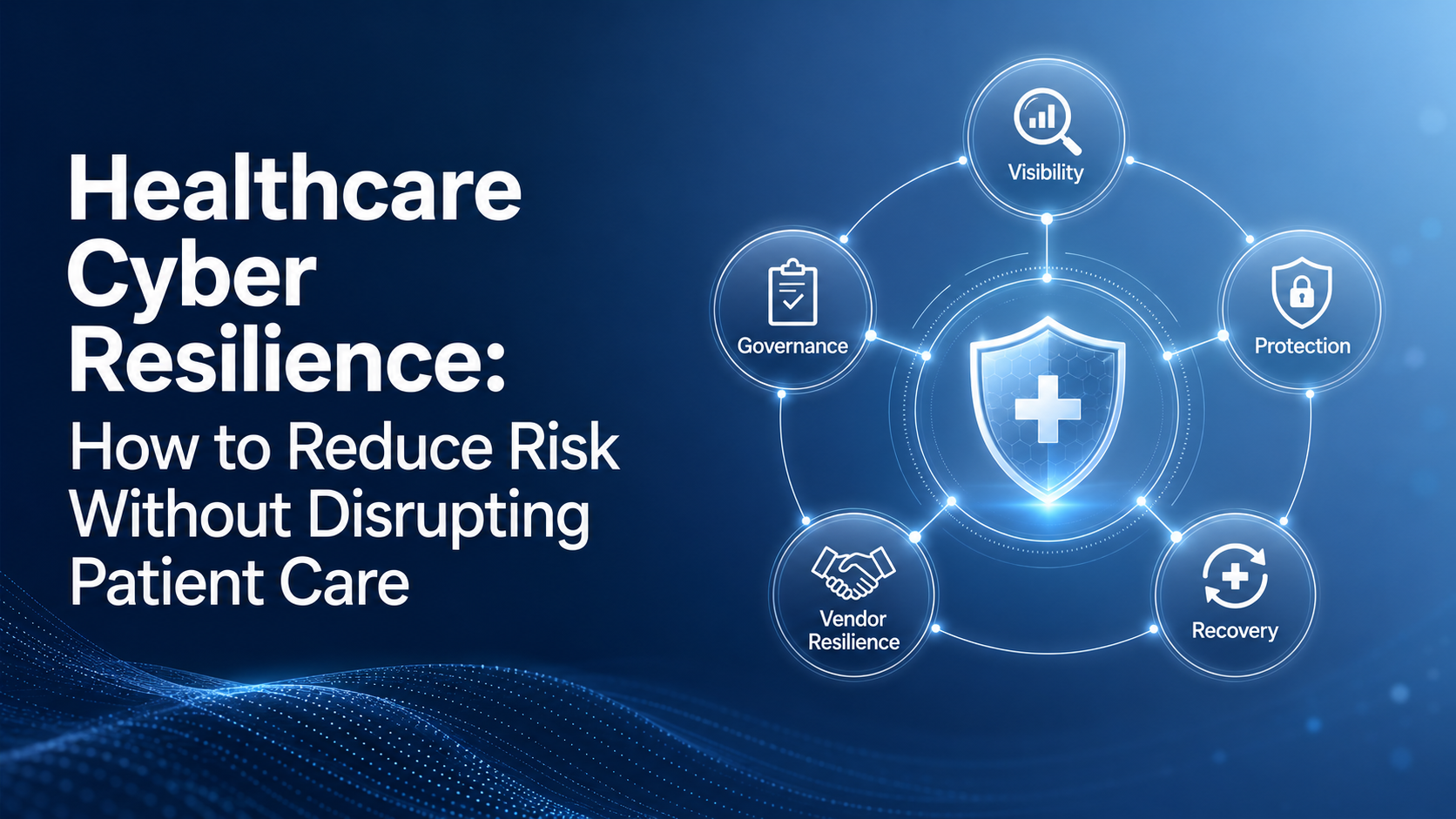
A resilient healthcare organization can do five things well:
- Know which systems and workflows matter most.
- Control access to sensitive systems and data.
- Detect trouble early and respond with less confusion.
- Restore critical operations, not just files.
- Maintain evidence that shows safeguards, reviews, and recovery activities are working.
Those capabilities support HIPAA readiness and daily operations.
The goal is not to create a perfect cybersecurity program overnight.
The goal is to reduce the likelihood that a single incident becomes a prolonged problem involving patient care, compliance, revenue, and trust.
Cybersecurity vs. Cyber Resilience
Cybersecurity and cyber resilience are connected, but they are not the same.
| Cybersecurity | Cyber Resilience |
| Focuses on protection | Focuses on continuity and recovery |
| Reduces the likelihood of incidents | Reduces the impact of incidents |
| Protects systems and data | Protects operations and patient care |
| Includes MFA, encryption, monitoring, and endpoint protection | Includes recovery, communications, vendors, downtime workflows, and executive response |
| Often led by IT and security teams | Requires IT, operations, compliance, leadership, vendors, and clinical input |
| Asks, “How do we prevent this?” | Asks, “How do we keep operating if this happens?” |
Healthcare organizations need both.
Cybersecurity reduces risk.
Cyber resilience reduces consequences.
The Systems Behind Patient Care
Most patients never think about the systems behind care delivery.
They notice when those systems fail.
A patient cannot reach the office by phone. A clinician cannot access medication history. A referral does not move. A billing team cannot submit claims. A care coordinator cannot reach a patient. A provider cannot document an encounter in the EHR.
That is why resilience planning should include the full technology ecosystem, not just security software.
Critical dependencies may include:
- EHR systems
- Practice management systems
- Patient portals
- Phone systems
- Contact centers
- Cloud applications
- Identity and access platforms
- Internet connectivity
- Local networks
- Endpoints and mobile devices
- Backup systems
- Billing platforms
- Referral workflows
- Telehealth systems
- Vendor portals
- Security monitoring platforms
For a deeper look at downtime impact, see The 72-Hour Recovery Objective: How Healthcare Practices Can Prepare for EHR, Phone, and Network Downtime
DataTel’s related article on EHR Downtime in Mental Health and SUD Care also shows how quickly technology downtime can become a care continuity issue.
A Practical Resilience Operating Model
Healthcare cyber resilience works best when it is simple enough for leadership to understand and practical enough for teams to use.
The following model organizes resilience into five connected capabilities.
1. Know What Patient Care Depends On
Visibility is the starting point.
Healthcare organizations cannot protect, monitor, or recover systems they have not identified.
This includes knowing:
- Where ePHI is created, received, maintained, and transmitted
- Which systems support patient care
- Which devices connect to the network
- Which vendors support critical operations
- Which systems are cloud-based
- Which users have privileged access
- Which workflows depend on phones, EHRs, networks, or third-party platforms
- Which applications would create the most disruption if unavailable
This is where asset inventories, network maps, risk analyses, vendor inventories, and operational dependency mapping become practical.
HHS risk analysis guidance states that all ePHI created, received, maintained, or transmitted by an organization is subject to the Security Rule, and that organizations must evaluate risks and vulnerabilities in their environments. 2
In plain language, that means leaders need a current view of what exists and what could go wrong.
For more detail, see HIPAA Risk Analysis vs. Vulnerability Scan: What Healthcare Practices Often Miss
DataTel’s Network and Server Management services can support the infrastructure visibility healthcare organizations need for better uptime, monitoring, and secure operations.
2. Control Access Before Access Becomes the Incident
Identity is one of the most important resilience issues in healthcare.
A stolen password can affect email, remote access, cloud applications, EHR systems, billing platforms, backup systems, and vendor portals. A dormant account can create unnecessary exposure. A privileged account with weak controls can turn a small incident into a larger one.
Access control should include:
- Multi-factor authentication
- Unique user accounts
- Privileged access controls
- Remote access review
- Vendor access review
- User onboarding and offboarding
- Periodic access reviews
- Administrative account monitoring
- Device and endpoint oversight
The proposed HIPAA Security Rule updates place strong emphasis on MFA, encryption, asset inventories, vulnerability management, recovery, and other cybersecurity safeguards, while the current Security Rule remains in effect. 3
For practical technical safeguard guidance, see Does HIPAA Require MFA, Encryption, Vulnerability Scanning, and Network Segmentation?
DataTel’s Cybersecurity and Device Management services can help healthcare organizations improve access visibility, endpoint oversight, monitoring, and risk reduction.
3. See Trouble Early and Respond With Less Confusion
Resilience depends on speed and clarity.
The earlier an organization detects a problem, the more options it usually has.
Monitoring and response capabilities help healthcare organizations identify suspicious behavior, investigate alerts, contain issues, coordinate vendors, and communicate with leadership.
This may include:
- Security monitoring
- Endpoint detection and response
- Log review
- Alert triage
- Vulnerability management
- Incident escalation procedures
- Response playbooks
- Tabletop exercises
- Leadership communication plans
- Post-incident documentation
This is especially important because healthcare incidents rarely remain neatly contained within a single system.
An endpoint alert may involve a user account. A user account may touch cloud applications. Cloud applications may affect ePHI. An incident may require a vendor. A vendor may influence recovery time.
Monitoring is not only about seeing threats.
It is about giving the organization time to act.
HHS OCR has continued to resolve HIPAA Security Rule investigations related to ransomware and risk analysis issues, reinforcing the importance of prevention, response, and evidence. 4
4. Recover Clinical Operations, Not Just Data
Recovery is where resilience becomes visible.
Backups are important. They are not enough by themselves.
A backup answers one question: Do we have a copy of the data?
Recovery asks a more useful question: can we restore the systems and workflows needed to serve patients?
Healthcare recovery planning should include:
- Backup validation
- Restoration testing
- Recovery runbooks
- EHR downtime workflows
- Phone and contact center continuity
- Network and internet recovery
- Cloud access procedures
- Vendor escalation paths
- Staff communication procedures
- Patient communication plans
- Recovery metrics
- Lessons learned
The proposed HIPAA Security Rule updates include more specific recovery-related expectations, including written procedures to restore certain relevant electronic information systems and data within 72 hours. 3
That language is proposed, not final.
Still, it is a useful readiness prompt.
If a ransomware event, outage, vendor disruption, or network failure occurred tomorrow, could your organization maintain care while restoring systems?
For more context, see The Hidden Cost of Downtime in Mental Health and Substance Use Disorder Care
DataTel’s VoIP Business Phone and Contact Center services can support continuity of communications, while Fully Managed IT can help organizations build a stronger operational foundation for recovery.
5. Keep Evidence Leadership Can Use
Resilience should create proof.
Not just for auditors. For leadership.
Evidence helps healthcare organizations demonstrate what is working, what has been tested, what remains unresolved, and where to invest next.
Useful evidence may include:
- MFA reports
- Access reviews
- Device inventories
- Vulnerability scan summaries
- Remediation records
- Backup logs
- Recovery testing records
- Incident response notes
- Security monitoring summaries
- Vendor assessments
- Business associate reviews
- Risk registers
- Executive dashboards
- Tabletop exercise findings
- Corrective action plans
This is where HIPAA readiness, cybersecurity maturity, and operational leadership come together.
A policy says what should happen.
Evidence shows what did happen.
For a deeper discussion, see HIPAA Policies Are Not Enough: What Evidence Healthcare Organizations Need to Prove Readiness
The DataTel Cyber Risk Hub can help organizations explore cyber maturity, domain exposure, Microsoft 365 posture, insurance readiness, CIRCIA readiness, and resilience indicators.
Where Vendors Fit Into Resilience
Healthcare organizations rarely operate alone.
They depend on EHR vendors, cloud providers, managed IT partners, cybersecurity providers, phone providers, billing platforms, telehealth services, backup providers, and other third parties.
That means vendor resilience is part of organizational resilience.
A vendor issue may affect:
- EHR availability
- Phone service
- Patient communication
- Billing
- Claims processing
- Backup restoration
- Security monitoring
- Remote access
- Cloud application availability
- Incident notification timing
A signed Business Associate Agreement matters, but it does not prove a vendor can protect ePHI or recover critical services.
Healthcare organizations should ask vendors:
- What systems or data do you support?
- Do you use MFA for administrative access?
- How do you monitor for security issues?
- How do you test recovery procedures?
- What are your recovery objectives?
- How quickly will you notify us during an incident?
- What evidence can you provide?
- Which subcontractors support our environment?
- Who do we contact during downtime?
For more guidance, see Are BAAs Enough for HIPAA? What Healthcare Organizations Should Ask Vendors and Business Associates
Communications Continuity Is Clinical Continuity
Phones and contact centers are sometimes treated as separate from cybersecurity and recovery planning.
In healthcare, they are not separate.
When phones go down, patients may be unable to reach the practice. Staff may struggle to coordinate care. Referral partners may hit dead ends. Scheduling teams may lose visibility. Leadership may have fewer channels for communication during an incident.
Communications continuity should be part of the resilience plan.
Ask:
- Can calls be rerouted during an outage?
- Can contact center teams operate from alternate locations?
- Can patients receive timely instructions?
- Can staff communicate if primary systems are unavailable?
- Are phone systems included in downtime exercises?
- Are voice systems dependent on the same network or internet connection as other critical services?
For healthcare organizations already using DataTel for voice or other communications, resilience planning is a natural next step in the conversation.
Voice uptime matters.
So do identity, endpoints, networks, monitoring, recovery, vendors, and evidence.
For decision-stage planning, see How to Choose a Healthcare IT, Cybersecurity, and Communications Provider
The Resilience Scorecard for Healthcare Leaders
A simple scorecard can help leadership see whether the organization is moving in the right direction.
| Resilience Area | Leadership Question | Evidence to Review |
| Critical systems | Do we know which systems support patient care? | Asset inventory, dependency map, system criticality list |
| Access control | Can we prevent and detect unauthorized access? | MFA reports, access reviews, privileged account records |
| Devices and endpoints | Do we know which devices are managed and protected? | Device inventory, patch reports, endpoint monitoring summaries |
| Monitoring and response | Can we detect and respond early? | Alert reports, incident logs, escalation procedures |
| Recovery | Can we restore operations, not just files? | Backup logs, recovery tests, downtime exercise records |
| Communications | Can patients and staff communicate during disruption? | Call routing plans, contact center continuity procedures |
| Vendors | Do critical vendors support our resilience goals? | BAAs, vendor assessments, recovery documentation |
| Evidence | Can we prove safeguards are working? | Reports, reviews, test results, remediation records |
| Governance | Does leadership see risk clearly? | Dashboards, risk registers, executive updates |
This scorecard is not meant to create another administrative burden.
It is meant to make risk easier to discuss.
Common Resilience Gaps That Stay Hidden Too Long
Healthcare organizations often discover resilience gaps only during an incident.
The goal is to find them earlier.
Gap 1: Strong Security, Weak Recovery
An organization may have MFA, endpoint protection, and monitoring, but limited recovery testing.
That poses a risk because prevention cannot prevent every outage or incident.
Gap 2: Backups Without Restoration Evidence
Backups may run every day, but if restoration has not been tested, leadership does not know how long recovery will take.
Gap 3: Phones Left Out of Downtime Planning
If the EHR is down, phones become even more important. If phones are unavailable as well, patient access suffers quickly.
Gap 4: Vendor Risk Treated as Paperwork
A BAA does not prove a vendor can support recovery, notify quickly, or protect privileged access.
Gap 5: Executive Reporting That Arrives Too Late
Leadership needs clear risk summaries before an incident, after one.
Gap 6: Evidence Scattered Across Systems
If evidence lives in email threads, portals, spreadsheets, dashboards, and ticketing systems, audit and incident response become harder.
How to Improve Resilience Without Disrupting Operations
Healthcare leaders often hesitate to begin cybersecurity improvement work because they worry it will disrupt already busy clinical teams.
That concern is valid.
A good resilience roadmap should improve readiness without creating unnecessary friction.
Start with targeted, practical steps:
- Expand MFA first where risk is highest.
- Review critical vendors before lower-risk vendors.
- Test one recovery workflow before attempting a full-scale exercise.
- Build one executive dashboard before overhauling every report.
- Document current downtime procedures before redesigning them.
- Review phone continuity and call routing before a real outage.
- Prioritize systems tied directly to patient care.
Resilience work does not need to stop operations.
It should help operations become more dependable.
What Healthcare Organizations Should Do in the Next 90 Days
A 90-day plan helps organizations move from broad concern to practical progress.
Days 1 to 30: Find the Exposure
Start by understanding the current state.
Recommended actions:
- Identify critical systems tied to patient care.
- Review where ePHI exists.
- Inventory key vendors and business associates.
- Review MFA coverage.
- Review endpoint and device visibility.
- Gather recent vulnerability findings.
- Review backup and recovery documentation.
- Identify dependencies on the phone, contact center, network, and internet.
- Review current executive reporting.
Start with DataTel’s free HIPAA Readiness Assessment to calculate downtime exposure, identify readiness gaps, and receive a prioritized 90-day roadmap.
Days 31 to 60: Test the Assumptions
Move from “we think” to “we know.”
Recommended actions:
- Conduct a tabletop exercise.
- Test backup restoration for one critical system.
- Review call routing and communications continuity.
- Review vendor recovery commitments.
- Perform access reviews.
- Review vulnerability remediation progress.
- Validate incident communication procedures.
- Document evidence gaps.
Finding issues during an exercise is not a failure.
It is the point.
Days 61 to 90: Make Readiness Visible
Turn findings into action.
Recommended actions:
- Expand MFA coverage where needed.
- Improve recovery runbooks.
- Strengthen vendor oversight.
- Update risk registers.
- Improve monitoring and escalation procedures.
- Centralize readiness evidence.
- Create an executive resilience summary.
- Assign owners and timelines for remaining gaps.
- Build the next 90-day improvement plan.
The goal is not perfection.
The goal is measurable progress that supports patient care.
Where DataTel Fits
Healthcare cyber resilience requires coordination across systems, vendors, communications, security, recovery, and leadership.
DataTel helps healthcare organizations bring those pieces into a clearer support model.
Managed IT Support
DataTel Fully Managed IT supports organizations that need comprehensive IT management, help desk, cybersecurity, cloud, device, network, server, and vendor support.
For organizations with internal IT teams, Co-Managed IT can add cybersecurity depth, escalation support, project help, and operational coverage.
Cybersecurity Readiness
DataTel Cybersecurity supports monitoring, threat detection and response, compliance support, risk assessments, vulnerability management, and security program improvement.
Infrastructure and Device Visibility
Network and Server Management and Device Management help organizations strengthen the operational foundation behind resilience.
Communications Continuity
VoIP Business Phone and Contact Center support patient access, call routing, communications continuity, and clinical coordination during disruption.
Risk Visibility
The Cyber Risk Hub helps organizations explore cyber maturity, exposure, insurance readiness, resilience, and related risk indicators.
Learn more about DataTel’s background, managed IT, cybersecurity, voice, connectivity, and healthcare support on the About DataTel page.
Take DataTel’s Free HIPAA Readiness Assessment
Healthcare cyber resilience begins with knowing where your organization stands today.
Take DataTel’s free HIPAA Readiness Assessment to evaluate readiness across:
- Access controls
- Recovery and resilience
- Compliance and audit readiness
- Governance and risk
The assessment includes readiness scoring, a clinical downtime impact calculator, and a prioritized 90-day roadmap.
Start here: Take the HIPAA Readiness Assessment
Frequently Asked Questions
What is healthcare cyber resilience?
Healthcare cyber resilience is the ability to anticipate, withstand, recover from, and adapt to cyber disruptions while maintaining critical operations and supporting patient care.
How is cyber resilience different from cybersecurity?
Cybersecurity focuses mainly on preventing and detecting incidents. Cyber resilience encompasses cybersecurity and also emphasizes recovery, business continuity, communications, vendor readiness, evidence, and operational adaptation.
Why does cyber resilience matter in healthcare?
Healthcare organizations depend on technology for EHR access, phones, scheduling, billing, referrals, prescriptions, documentation, and patient communications. Resilience helps those functions continue during disruptions.
What are the core components of healthcare cyber resilience?
Core components include access control, endpoint and device management, monitoring and response, backup and recovery, communications continuity, vendor readiness, and evidence documentation.
How does cyber resilience support patient care?
Cyber resilience helps organizations maintain access to critical systems, communicate with patients and staff, continue clinical workflows, recover faster, and reduce confusion during outages or cyber incidents.
What role do phones and contact centers play in resilience?
Phones and contact centers support patient access, scheduling, referrals, internal coordination, and incident communication. They should be included in downtime and recovery planning.
How do vendors affect healthcare cyber resilience?
Many healthcare operations depend on vendors. EHR providers, cloud platforms, phone providers, billing vendors, backup providers, and managed IT partners can directly affect recovery, patient access, and operational continuity.
Does cyber resilience help with HIPAA readiness?
Yes. Many resilience activities support HIPAA readiness, including risk analysis, access controls, recovery planning, documentation, monitoring, vendor oversight, and evidence collection.
How often should resilience plans be tested?
Healthcare organizations should test resilience plans periodically and whenever significant technology, vendor, workflow, or operational changes occur.
What is the first step toward improving healthcare cyber resilience?
The first step is visibility. Healthcare organizations should identify critical systems, ePHI locations, vendors, access risks, recovery capabilities, and current evidence gaps.