The most common misconception about the CIRCIA clock
Many teams assume the 72-hour clock starts when the attacker gains access.
That assumption will get you in trouble.
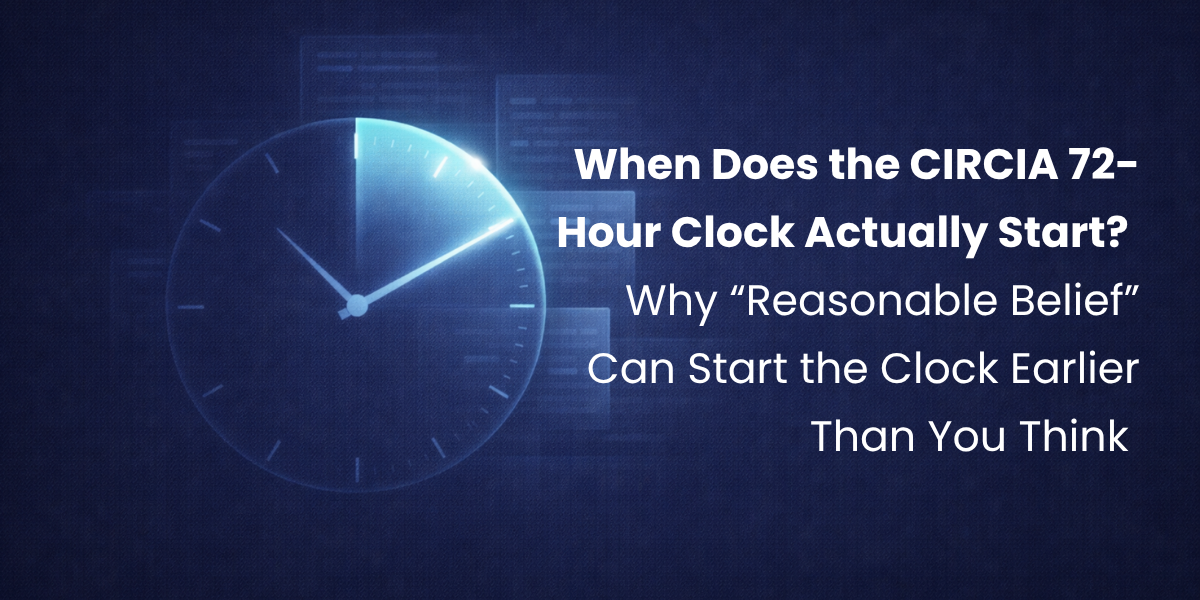
Under CIRCIA, the reporting timeline is tied to when a covered entity reasonably believes a covered cyber incident occurred, not when the incident itself began. The statute is explicit that the deadline cannot be earlier than 72 hours after that reasonable belief point.
https://www.law.cornell.edu/uscode/text/6/681b
Why this matters is simple: incidents don’t arrive in a neat package. They unfold.
You might see suspicious sign-ins, then spend half a day pulling logs, then learn a vendor had an issue, then realize a core system is affected. Somewhere in that sequence, your team crosses a line from “we’re looking into it” to “we have enough to say this likely happened.”
That’s the moment that matters.
CISA’s proposed rulemaking also reinforces the operational reality: organizations may need to submit an initial report before the investigation is complete, then follow up as facts mature.
https://www.federalregister.gov/documents/2024/04/04/2024-06526/cyber-incident-reporting-for-critical-infrastructure-act-circia-reporting-requirements
CISA’s NPRM overview makes the same point in plain terms. It’s about reasonable belief, not perfect forensic certainty.
https://www.cisa.gov/sites/default/files/2024-04/CIRCIA%20NPRM%20Overview%20V2%28FINAL%29_508c%20%28locked%29.pdf
If you’re building workflows, this is the difference between “we’ll report once we know everything” and “we’ll report once we can support the basics.”
What “reasonable belief” means in practice
“Reasonable belief” is not a courtroom standard. It’s an operations standard.
It means you have enough evidence to conclude a covered cyber incident likely occurred, even if you’re still confirming scope, root cause, and downstream impact.
This is also how other federal reporting frameworks work. In the financial sector, for example, incident notification can be triggered once an organization forms a reasonable belief that a reportable incident occurred, not once every investigative detail is nailed down.
https://ncua.gov/regulation-supervision/letters-credit-unions-other-guidance/cyber-incident-notification-requirements
NIST’s incident response guidance supports the same operational posture: escalate based on sufficient evidence and observed impact, not on “we finished the investigation.”
https://nvlpubs.nist.gov/nistpubs/SpecialPublications/NIST.SP.800-61r3.pdf
The practical takeaway: the CIRCIA clock often starts during your investigation, not after it.
Four scenarios that can start the clock earlier than expected
Most teams don’t “decide” reasonable belief in one dramatic moment. It usually lands quietly, in a Slack message, a phone call with a vendor, or a short incident update to leadership.
Here are the situations where that line gets crossed faster than people expect.
1) A security analyst confirms malicious activity
This is the classic, “we’ve seen enough.”
Not “we have every IOC mapped,” just… enough to say it’s real.
Examples:
- Confirmed ransomware activity
- Unauthorized admin access
- Malware is spreading across multiple systems
- A verified data exfiltration signal
CISA’s covered cyber incident guidance includes scenarios like ransomware attacks, significant operational disruption, and serious compromises.
https://www.cisa.gov/resources-tools/resources/covered-cyber-incident-fact-sheet
When your SOC moves from “suspicious” to “confirmed malicious,” you may already be close to reasonable belief, even if the blast radius is still fuzzy.
2) Endpoint, identity, or network tools show a major compromise
Sometimes you don’t have a full narrative yet, but your tools are loud in a very specific way.
Examples:
- EDR is showing mass encryption behavior
- Identity logs showing privilege escalation or impossible travel patterns across privileged accounts
- Network telemetry indicating command-and-control traffic from multiple hosts
Even if you’re still validating which systems are affected, the combination of credible telemetry plus meaningful risk can push you into reasonable belief.
CISA’s one-pager on covered cyber incidents is helpful here, especially when incidents involve disruption or significant compromise indicators.
https://www.cisa.gov/sites/default/files/2024-05/24-0630-CCI-One-Pager-20240410-2-508c.pdf
3) A vendor notifies you of a breach or compromise
This one catches organizations off guard because the “starting signal” arrives from outside.
Examples:
- A SaaS provider reports unauthorized access tied to your tenant
- A cloud provider flags compromised accounts or suspicious activity in your environment
- An MSP identifies malware in a shared toolset or admin plane
In these cases, the clock may begin when you receive the notification, and you have enough context to reasonably believe your systems or operations are affected.
This is why vendor handoffs matter so much. If you don’t know who can confirm what, and how quickly, you spend precious hours waiting on the very evidence that would help you make the call.
4) Operational disruption + evidence of cyber activity
In critical infrastructure environments, disruption is often the moment leadership pays attention.
Examples:
- hospital systems unavailable due to ransomware
- water treatment controls are disrupted or behaving unexpectedly
- electric utility systems showing unexplained anomalies tied to access events
Sometimes you don’t yet have a root cause, but you have a service impact people can feel, and early evidence it’s cyber-related. That combination can quickly form a reasonable belief.
NIST’s incident response guidance supports escalating based on operational impact and available evidence, rather than waiting for perfect attribution.
https://nvlpubs.nist.gov/nistpubs/SpecialPublications/NIST.SP.800-61r3.pdf
Why documentation and timestamp ownership matter
Once a reasonable belief is reached, you need to be able to answer one question later, calmly, with receipts:
When did we reasonably believe this was a covered cyber incident, and what was that belief based on?
That’s not just good practice. It’s defensibility.
NIST emphasizes maintaining incident timelines and decision records, including when the incident was detected, when malicious activity was confirmed, when leadership was notified, and when key decisions were made.
https://nvlpubs.nist.gov/nistpubs/SpecialPublications/NIST.SP.800-61r3.pdf
One small move that helps more than people expect: assign a timeline owner. Not the lead investigator. Someone whose job is to keep timestamps clean, sources attached, and updates consistent while everyone else is chasing containment and recovery.
Also, document the “belief moment” the way you’d document a major change window:
- Who made the call
- What evidence was available at that time
- What was still unknown
- What actions followed (escalation, vendor outreach, drafting the initial narrative)
CIRCIA also includes an enforcement process that can escalate when reporting requirements aren’t met, including requests for information and potential subpoenas.
https://www.law.cornell.edu/uscode/text/6/681d
You don’t want to reconstruct this after the fact.
How to prepare before an incident happens
Most organizations don’t struggle because they misunderstand the statute. They struggle because they’ve never pressure-tested the timeline.
Here are three practical ways to tighten the workflow.
Assign reporting ownership
Decide, in advance:
- Who determines when a reasonable belief is reached
- Who owns the reporting decision
- Who drafts the initial incident narrative
- Who reviews it (legal, leadership, compliance)
If you don’t define this ahead of time, you’ll lose hours during an incident just trying to find the decision lane.
Improve evidence visibility
A lot of delay comes from not being able to confirm what’s happening quickly.
Centralized logging and basic telemetry hygiene shorten the time between detection and reasonable belief, because you can validate what you’re seeing instead of guessing.
CISA’s Logging Made Easy is a practical resource for improving log collection without turning it into a massive project.
https://www.cisa.gov/resources-tools/services/logging-made-easy
Test the timeline
Tabletop exercises are where the gaps show up, especially around vendors and approvals.
CISA provides tabletop exercise packages that work well as a starting point.
https://www.cisa.gov/resources-tools/services/cisa-tabletop-exercise-packages
When you run the exercise, measure two things:
- time to confirm the incident (or reach a reasonable belief)
- time to produce a usable initial narrative, leadership can sign off on
If those steps take more than 48 hours in an exercise, they will take longer in a real incident.
Conclusion: the clock starts earlier than most organizations expect
CIRCIA’s 72-hour reporting timeline does not begin when the cyberattack occurs.
It begins when you reasonably believe a covered cyber incident occurred.
https://www.law.cornell.edu/uscode/text/6/681b
Because investigations evolve, that belief moment often happens earlier than teams expect, sometimes with an incomplete scope and a vendor still confirming details.
Organizations that handle this well don’t chase perfection on day one. They build a workflow that supports early facts, clean timelines, and clear ownership, then they update as the story develops.
Continue the CIRCIA readiness series
CIRCIA in 2026: What Covered Entities Must Prepare for Now
circia-2026-covered-entities-what-to-do-now
Are We a Covered Entity? CIRCIA Scope Tests
circia-covered-entity-quick-test
72 Hours vs 60 Days: Harmonizing CIRCIA With Other Reporting Laws
circia-72-hour-unified-timeline